Eastern and Formosan subterranean termite colonies exploit high Lowcountry water tables and sandy loam soils to breach historic brick piers, masonry foundations, and crawlspace framing. In historic districts like…
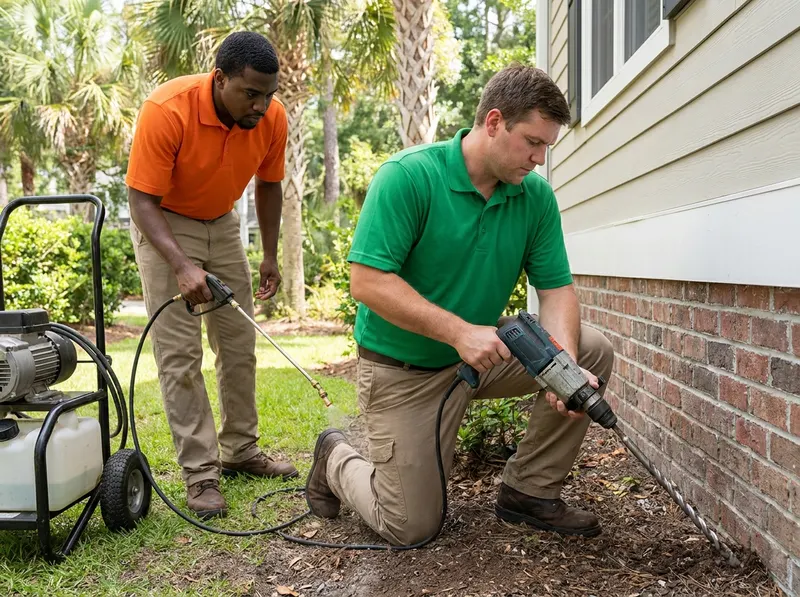
Eastern and Formosan subterranean termite colonies exploit high Lowcountry water tables and sandy loam soils to breach historic brick piers, masonry foundations, and crawlspace framing. In historic districts like Harleston Village and South of Broad, solid brick foundations and low-clearance crawlspaces require exact liquid soil rod injection rather than surface misting. Formosan subterranean termites consume southern yellow pine timber rapidly, requiring a continuous non-repellent barrier containing 0.06% liquid fipronil along every linear foot of interior and exterior foundation walls. A South Carolina CL-100 report is legally distinct from a routine pest spray: it is a standardized inspection document regulated by the Clemson University Department of Pesticide Regulation evaluating active wood-destroying organisms, past structural damage, and wood moisture levels exceeding 20% in substructure framing.
Property structures in Hampton Park Terrace, Radcliffeborough, and Wagener Terrace frequently feature ground clearances under 18 inches, creating microclimates where ambient relative humidity routinely exceeds 75%. If foundation timbers show moisture readings of 28% or higher, subterranean termites establish satellite aerial colonies without soil contact. Liquid chemical barriers establish an undetectable lethal perimeter around masonry stem walls and structural support piers, allowing returning worker termites to transfer the active toxicant directly into the subterranean nesting structure. A liquid soil treatment provides continuous perimeter exclusion without requiring disruptive floorboard removal inside historic rooms.
Slab-on-grade construction common across Daniel Island, West Ashley, and James Island demands precision drilling through exterior concrete walkways or garage aprons every 12 inches to saturate sub-slab soils where plumbing penetrations enter the foundation. In contrast, raised historic homes require full perimeter trenching 6 inches wide by 6 inches deep around every individual brick pier, followed by applying 4 finished gallons of dilution per 10 linear feet. The primary trade-off involves chemical soil treatment versus bait stations: liquid barrier treatments immediately stop active structural consumption by lethal contact within 30 to 90 days, whereas subterranean monitoring bait stations rely on delayed consumption over 6 to 18 months. Property closings requiring immediate clearance letters require verified liquid barrier defense when active shelter tubes appear on foundational brickwork.
Every job gets a firm, written price after a free on-site visit.
Tell us about your subterranean termite treatment & cl-100 clearances job in Charleston and we'll send a clear, written quote, usually the same day.
 Zorvexa Pest Solutions