Coastal South Carolina landscapes face severe entomological pressures due to hyper-humid microclimates and extended growing seasons. In Charleston County, turf varieties such as St. Augustine (Stenotaphrum secundatum)…
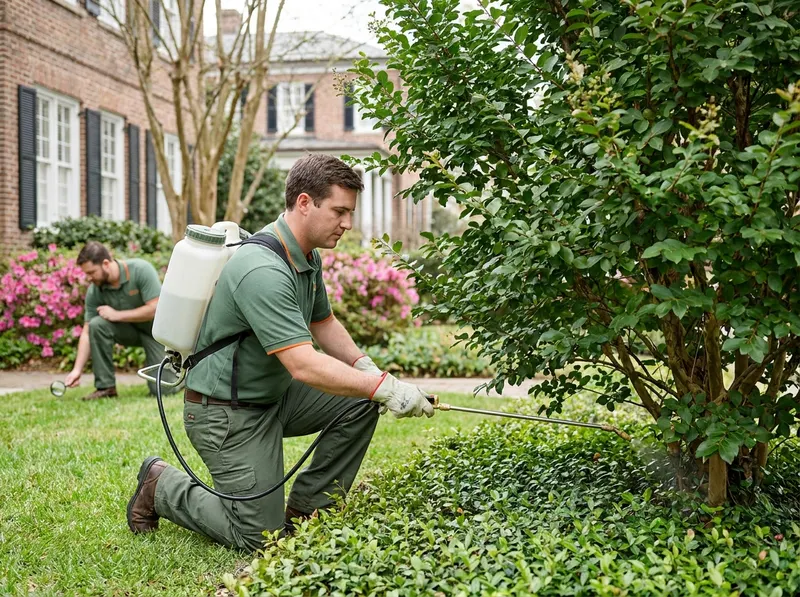
Coastal South Carolina landscapes face severe entomological pressures due to hyper-humid microclimates and extended growing seasons. In Charleston County, turf varieties such as St. Augustine (Stenotaphrum secundatum) and Zoysia face aggressive colonization by southern chinch bugs and hunting billbugs, while live oaks, crape myrtles, and palmettos harbor soft scale and wood-boring populations. Standard residential pest control often relies on perimeter foundation bands that fail to resolve parasitic invertebrate cycles feeding within deep turf thatch or inside vascular plant cambium. Effective management requires vascular translocation and precise soil-zone applications that penetrate 2 to 4 inches below the root line.
Selecting systemic vascular injection over conventional canopy misting provides critical advantages in historic urban lots. In dense downtown environments like South of Broad, Harleston Village, and Radcliffeborough, spray drift poses direct exposure risks to ornamental koi ponds, domestic pets, and adjacent historic brickwork. Trunk macro-infusion introduces targeted systemic compounds directly into xylem tissue, circulating active ingredients entirely within the plant structure. Conversely, expansive coastal lawns in Daniel Island, West Ashley, and James Island often require targeted entomopathogenic or insect growth regulator drenches to eradicate sub-surface mole crickets without damaging non-target beneficial predators.
Execution follows an exact three-step sequence. First, a specialist measures turf thatch depth and identifies specific vascular damage indicators on specimen trees near Hampton Park and Wagener Terrace. Second, technicians execute micro-injections at the root flare using low-pressure closed systems or apply calibrated sub-surface granular barriers across active turf infestation zones. Third, technicians record soil moisture and foliage absorption rates, leaving clear baseline data for property documentation. Standard baseline applications require a minimum investment of $250, with expansive estate grounds or deep historic canopies priced according to trunk diameter and square footage after direct visual appraisal.
Every job gets a firm, written price after a free on-site visit.
Tell us about your ornamental tree & turf invertebrate management job in Charleston and we'll send a clear, written quote, usually the same day.
 Zorvexa Pest Solutions