Decisive Lowcountry barrier defense requires deliberate entomological containment tailored to the brackish hydrology of Charleston County. Coastal humidity and daily tidal influxes create relentless breeding pressures,…
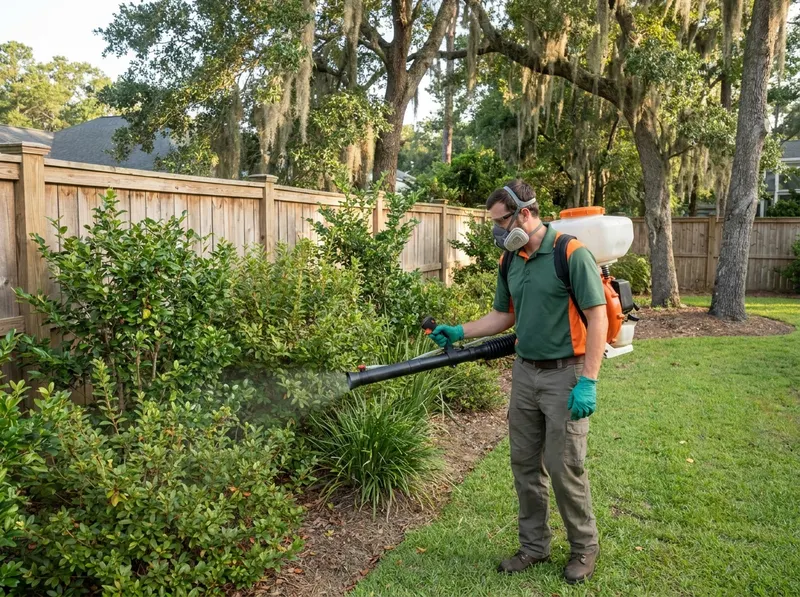
Decisive Lowcountry barrier defense requires deliberate entomological containment tailored to the brackish hydrology of Charleston County. Coastal humidity and daily tidal influxes create relentless breeding pressures, particularly for floodwater species such as Aedes taeniorhynchus in marsh-adjacent tracts of West Ashley and James Island, as well as container-breeding Aedes albopictus in dense urban courtyards across Harleston Village and South of Broad. Conventional misting that merely disperses airborne aerosols fails because rainfall washes non-bonding chemistries into the watershed. True barrier containment employs heavy micro-encapsulated polymers that adhere directly to the undersides of broadleaf foliage, dense ivy beds, wax myrtles, and low-hanging crepe myrtles where adult vectors harbor during peak thermal hours.
The mechanical application avoids flowering blooms, pollinator forage pathways, and active koi ponds, directing the product exclusively to dense perimeter boundaries, shaded drainage margins, and raised brick foundation perimeters common in historic Radcliffeborough and Hampton Park Terrace. For properties bordering the Wando and Cooper rivers on Daniel Island, technicians integrate solid biological larvicides containing Bacillus thuringiensis israelensis (BTI) into standing water catchments, French drains, and irrigation vaults. BTI specifically disrupts mosquito larval gut biology without impacting non-target wildlife, pets, or soil microbes.
Property owners selecting a seasonal control protocol face a direct operational trade-off: localized single-event treatments provide rapid adult knockdown for private outdoor gatherings lasting 14 to 21 days, whereas sustained bi-weekly barrier maintenance disrupts consecutive generational hatching cycles across the full March-through-November Lowcountry breeding season. If a parcel features heavy live oak canopies and closed perimeter walls like those near Hampton Park and Wagener Terrace, foliage retention preserves the residual barrier significantly longer than open, wind-scoured turf exposed to coastal salt air. Service verification occurs on-site to map drainage gradients, confirm boundary footage, and calibrate chemical volumes to local microclimates without requiring long-term contractual lock-ins.
Every job gets a firm, written price after a free on-site visit.
Tell us about your barrier mosquito control job in Charleston and we'll send a clear, written quote, usually the same day.
 Zorvexa Pest Solutions