Crawlspace moisture remediation establishes structural control over subterranean biological threats in coastal environments. In Charleston County, prolonged ambient relative humidity consistently exceeds 70%, forcing…
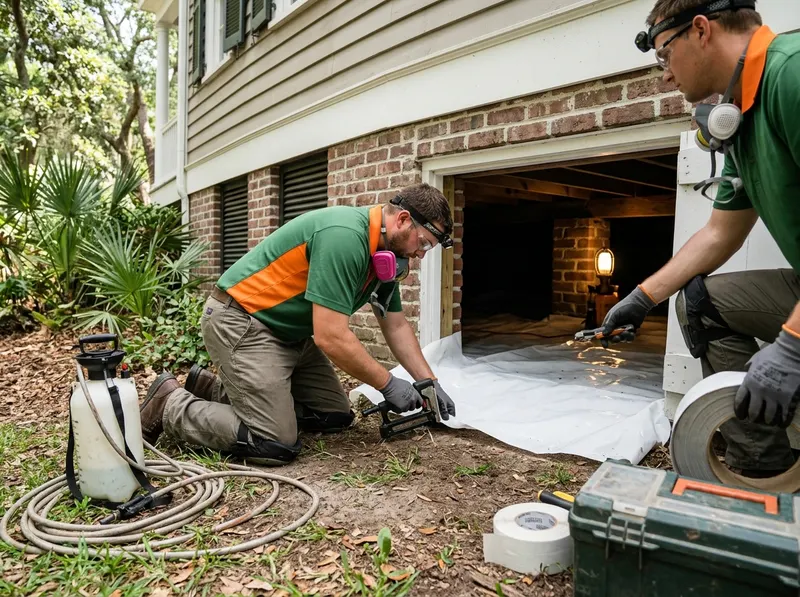
Crawlspace moisture remediation establishes structural control over subterranean biological threats in coastal environments. In Charleston County, prolonged ambient relative humidity consistently exceeds 70%, forcing unconditioned foundation spaces past the critical 20% wood moisture equivalent threshold. Once timber hits this moisture density, wood-rotting fungi (*Coniophora puteana*) and subterranean termites thrive simultaneously. Remediation functions by altering this physical environment: deploying commercial antimicrobial washings to terminate surface spores, extracting decaying insulation, and installing sealed 12-mil to 20-mil reinforced polyethylene barriers across the entire earth floor and foundation piers. This mechanical separation eliminates ground dampness evaporation into subfloor joists without relying on continuous interior pesticide applications.
Historic raised foundations across South of Broad, Harleston Village, and Radcliffeborough require distinct operational protocols compared to mid-century slab-and-pier homes in West Ashley or newer builds on Daniel Island. Historic brick piers and heart-pine sills absorb groundwater via capillary action, demanding vapor-permeable drying techniques rather than indiscriminate spray-foam insulation, which traps trapped moisture against historic framing. In Hampton Park Terrace and Wagener Terrace, coastal flood plains and high water tables produce standing ground saturation after heavy rainfall. If subfloor joist moisture measures below 16%, passive perimeter drainage and a vapor barrier offer adequate defense. If timber moisture registers above 20% with widespread fungal blooms, full encapsulation paired with an Energy Star commercial dehumidifier rated for 70 to 110 pints per day is necessary to maintain equilibrium below 55% relative humidity.
Remediation operations follow four definitive execution phases: 1. Complete subfloor diagnostics measuring ambient relative humidity, wood moisture content, and foundational structural integrity. 2. Manual extraction of soaked, rodent-fouled, or mold-laden fiberglass insulation down to bare joists. 3. Application of non-volatile botanical or quaternary ammonium antimicrobial solutions directly to the timber envelope. 4. Precision installation of heavy-duty ground barriers sealed with specialized mastic tape, supplemented by condensate drainage integration. Properties on James Island that bypass encapsulation face accelerated fungal regrowth and recurrent pest infiltration, as open foundation vents actively draw warm, moisture-laden coastal air directly onto cooled air-conditioning ductwork.
Every job gets a firm, written price after a free on-site visit.
Tell us about your crawlspace mold & moisture remediation job in Charleston and we'll send a clear, written quote, usually the same day.
 Zorvexa Pest Solutions